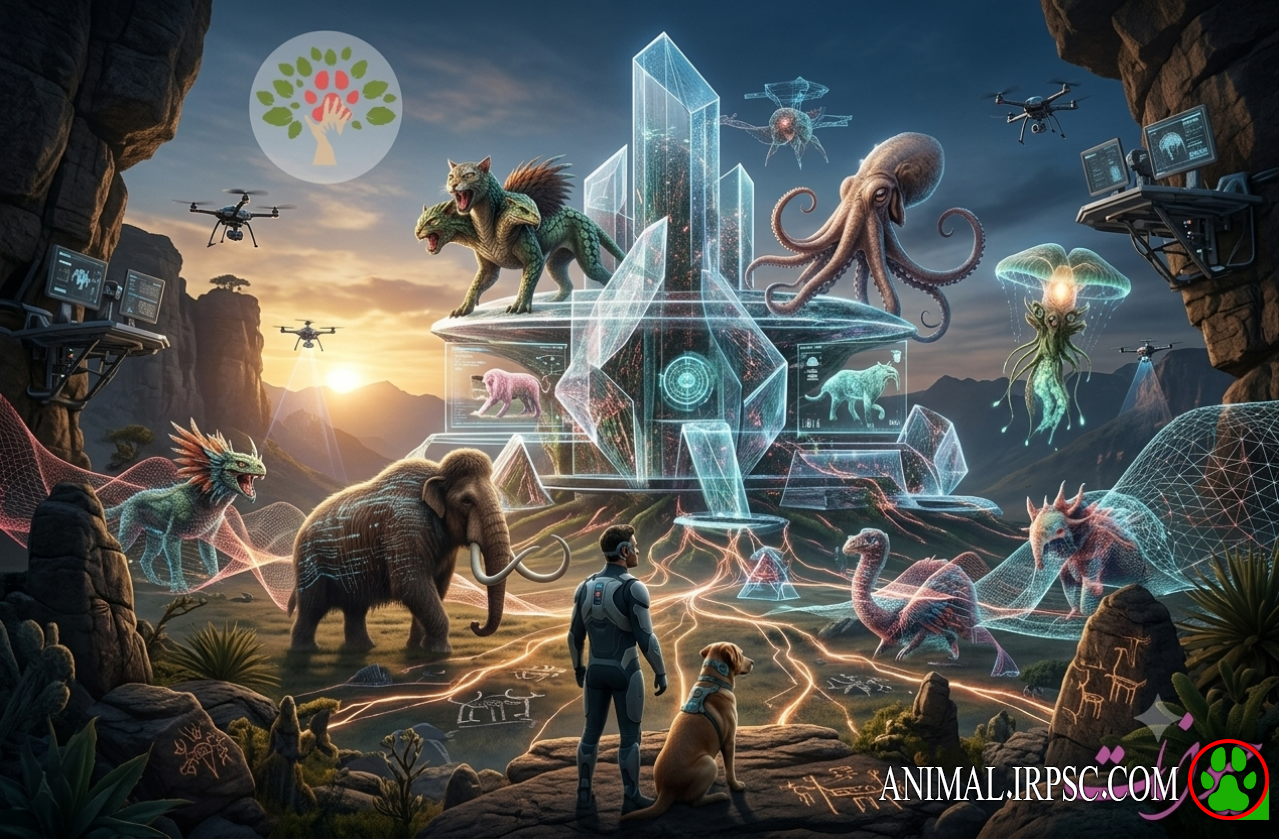
The survival of nature and the shared ecosystem with animals by entering the world of color metaverse
The Future of Iran’s Natural Ecosystems and Metaverse Rang
Standard Question
Could the survival of Iran’s natural ecosystems depend on the development and future of Metaverse Rang?
Short Answer
Metaverse Rang alone cannot guarantee the survival of Iran’s natural ecosystems. However, if it is designed as a digital infrastructure for understanding, simulating, educating, engaging, and financing nature conservation, it could become an effective conservation tool.
From this perspective, Iran’s nature should not be protected only in the physical world. A digital, interactive, and data-driven representation of ecosystems could make it possible to monitor environmental changes, provide public education, engage local communities, and attract resources for conservation.
Therefore, the relationship between nature and the metaverse is not one of replacement, but rather one of strengthening conservation capacity.
Curiosity-Driven Question
If one day we could keep a forest, wetland, or endangered ecosystem alive, visible, and experienceable in the digital world, could this digital representation help save its real-world counterpart?
Standard Analysis
Problem Identification
At first glance, this question is about the future of Metaverse Rang. However, its deeper issue is a civilizational challenge:
How can digital technologies be used to increase our capacity to understand, protect, and restore natural ecosystems in response to their gradual destruction?
Iran contains a wide range of ecosystems, from the Hyrcanian forests and wetlands to mountainous, desert, and coastal regions. Protecting these resources is not merely an environmental issue; it is also connected to the economy, culture, food security, water, tourism, education, and the future of local communities.
From this perspective, Metaverse Rang becomes relevant to environmental protection when it moves beyond being a purely representational space and becomes an infrastructure for environmental representation, monitoring, simulation, and participation.
Analytical Explanation
One of the first capabilities of the metaverse in this field is making nature observable and experienceable. Many environmental degradation processes are invisible or inaccessible to ordinary citizens. Creating digital twins of ecosystems could represent changes in vegetation cover, water resources, biodiversity, and climate conditions through spatial and understandable experiences. In such a model, Spatial Computing could act as a bridge between scientific data and human experience.
The next stage is where its real value becomes more significant: future simulation. If an ecosystem has a dynamic model in the digital world, different scenarios can be examined. For example, what would happen if the water level of a wetland declined, forest cover disappeared, or land-use patterns changed? At this point, the metaverse evolves from a “picture of nature” into a “laboratory for the future of nature.”
The third dimension is the conservation economy. A digital ecosystem could create new pathways for financing environmental projects, virtual ecotourism, education, public support, and economic participation. However, this area requires transparent governance so that the economic value of nature does not lead to destructive commercialization or inappropriate ownership of environmental data.
Therefore, the future of Metaverse Rang should not be defined as an absolute causal relationship with the survival of nature. A more precise question is:
Can the metaverse become one of the civilizational infrastructures for protecting Iran’s natural ecosystems?
This shift transforms the question from a technological claim into a serious future-oriented research problem.
Conceptual Distinctions
Nature Representation ≠ Nature Conservation
Creating a digital version of a forest or wetland does not, by itself, protect the real ecosystem. Its value emerges when it is connected to knowledge, decision-making, action, and conservation investment.
Digital Twin ≠ Virtual Replica
A digital twin must be continuously updated using real-world data. A beautiful but static 3D model does not qualify as a digital twin.
Virtual Experience ≠ Replacement for Nature
The metaverse should not replace real experiences of nature with virtual ones. Its desirable purpose is to increase understanding, accessibility, education, and motivation for conservation.
Digital Economy ≠ Conservation Economy
Generating revenue from digital representations of nature becomes meaningful when part of the value created can return to the real and sustainable protection of ecosystems.
Data-Driven Insight
The future of ecosystem conservation will increasingly depend on combining geographic data, remote sensing, satellite imagery, sensors, climate modeling, biodiversity data, and artificial intelligence.
The metaverse can serve as the experience and interaction layer for these datasets, transforming complex scientific information into environments that can be visualized and understood by researchers, managers, investors, students, and citizens.
For this reason, the value of an “environmental metaverse” should not be measured primarily by the number of users or by graphical attractiveness. More important indicators include data accuracy, update frequency, modeling quality, predictive capability, and the extent to which digital experiences are transformed into real conservation action.
Knowledge-Driven Insight
This question lies at the intersection of ecology, environmental science, remote sensing, artificial intelligence, digital architecture, environmental economics, social sciences, and futures studies.
From this perspective, the metaverse can be considered a new cognitive layer for human civilization—a layer in which humans model and experience not only the built environment but also natural processes.
If developed properly, Ariana Digital Island and Metaverse Rang could move beyond merely displaying digital assets and become a platform for environmental memory, ecological education, and decision-making about the future of the land.
Scientific and Technical Refinement
Key Concepts
-
Digital Twin of Ecos
Image gallery