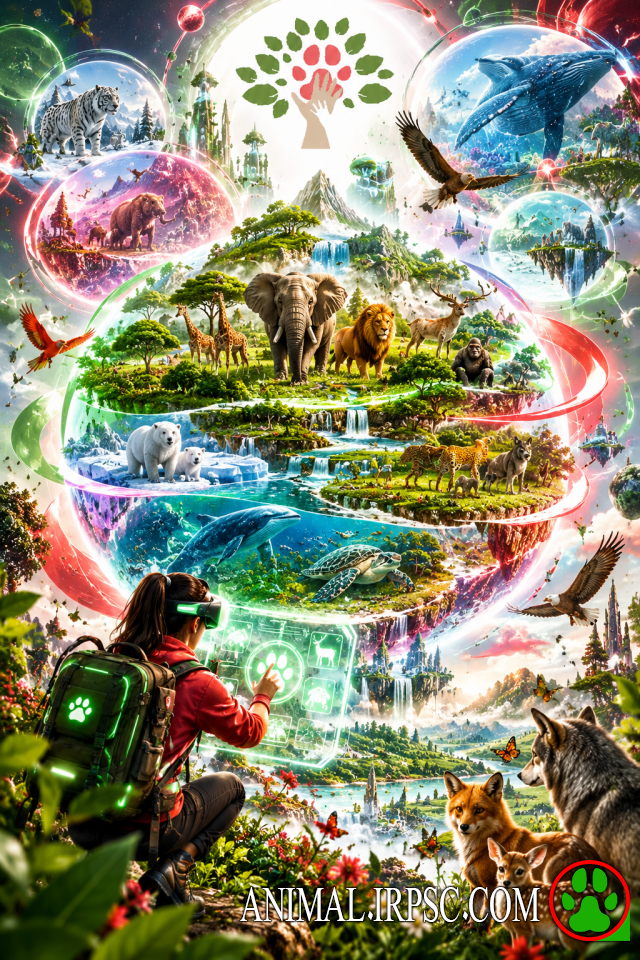
Animal systems: the cornerstone of the intelligent ecosystem of metaverse worlds and the path to the formation of biosecurity in the multiverse
حتماً. متن بسیار طولانی است؛ میتوانم آن را به انگلیسی با حفظ ساختار مقاله، تیترها، لحن علمی-آیندهنگرانه، اصطلاحات تخصصی، کلیدواژههای SEO و منابع ترجمه کنم.
Animal System: The Cornerstone of Smart Ecosystems in Metaverse Worlds and the Path Toward Bioguardianship in the Multiverse
Suggested SEO Title: Animal System; Bioguardianship, Biodiversity, and the Future of Nature in the Metaverse and Parallel Worlds
Meta Description: A scientific and forward-looking exploration of the role of the Animal System in designing multilayered metaverse ecosystems, restoring biodiversity, environmental education, augmented reality, and the emergence of the bioguardian citizen in parallel worlds.
Focus Keyword: Animal System in the Metaverse
Related Keywords: metaverse bioguardianship, metaverse environment, digital biodiversity, parallel worlds, multiverse, augmented reality, animal conservation, environmental education, virtual ecosystem, bioguardian citizen, environmental game, de-extinction of species
Suggested URL Structure: animal-system-metaverse-biodiversity-bioguardians
Scientific Note: In this article, the “Animal System” and the “Rang Metaverse Bioguardian” model are examined as a proposed concept and architecture, rather than as an established scientific standard or a project that has already been formally recognized under these names in the academic literature. The scientific evidence cited supports the foundations of conservation biology, environmental education, augmented/virtual reality, citizen science, and biodiversity governance; connecting these foundations to a metaverse architecture is a design-oriented and foresight-based proposal.
Introduction: If the Metaverse Is Supposed to Be a World, Where Is Its Nature?
In its simplest definition, the metaverse should not merely be a collection of digital buildings, marketplaces, games, avatars, and social spaces. If future virtual worlds are to evolve toward sustainable, complex, and self-developing structures, one of the most fundamental questions is: How will the ecosystems of these worlds be formed?
In the real world, no civilization exists without nature. Humans live within a complex network of species, ecosystems, water cycles, soil, carbon, pollination, food webs, and interspecies relationships. Therefore, if future digital worlds are not merely representations of humanity but are to become independent, dynamic “worlds” with their own internal logic, the presence of non-human life in their architecture will not be merely decorative. It could become part of their identity, educational, and even economic infrastructure.
The importance of this issue becomes even clearer when we consider the state of biodiversity in the real world. The global IPBES assessment has warned that approximately one million animal and plant species are threatened with extinction and that current extinction rates are significantly higher than historical natural rates.
The latest data published by the IUCN also show that extinction-risk assessments have been formally recorded for tens of thousands of species, while the Red List remains one of the world's most important infrastructures for assessing species status and informing conservation decisions.
Under these circumstances, the idea of creating an Animal System within a metaverse world can be understood as more than an entertainment project: it can be envisioned as a digital architecture for simulation, education, citizen participation, biological knowledge management, nature experiences, and the design of new models of interaction between humans and life.
1. Why Does the Metaverse Need an Ecosystem?
An ecosystem is not merely a collection of living organisms. It is a network of organisms, their physical environment, and the interactions among them.
In the real world, a forest cannot be reduced to a few trees and animals. A forest is formed through the interaction of soil, water, fungi, plants, insects, birds, mammals, microorganisms, light, temperature, and biological processes.
Therefore, if we want to introduce the concept of an “ecosystem” into metaverse worlds, we must go beyond three-dimensional representations of animals and move toward dynamic digital ecosystems.
Within such a structure, each species could:
-
have a defined habitat;
-
have defined behavior and movement patterns;
-
interact with other species;
-
respond to environmental changes;
-
have a life cycle;
-
occupy a position within a food web;
-
play a role in pollination or seed dispersal;
-
be affected by climate change or habitat destruction;
-
and ultimately become part of a larger model of digital life.
This is where the “Animal System” can move beyond being a virtual zoo and become a biological infrastructure for metaverse worlds.
This perspective is also consistent with contemporary approaches to nature conservation. The Kunming–Montreal Global Biodiversity Framework emphasizes maintaining and restoring ecosystem integrity, connectivity, and resilience while reducing the risk of species extinction.
2. The Animal System: From a Digital Project to a “Biological Infrastructure”
In the proposed architecture, the Animal System could be defined as one of the first biological layers of the Rang Metaverse worlds.
This system could contain five main layers:
Layer One: The Biological Database
This layer would record species information, including:
-
scientific name;
-
biological classification;
-
habitat;
-
conservation status;
-
diet;
-
behavior;
-
geographical distribution;
-
relationships with other species;
-
existing threats;
-
and conservation-related data.
This model could use authoritative scientific sources such as the IUCN Red List as one of its data references. The IUCN Red List provides information on species distribution, populations, habitats, threats, and conservation actions.
Layer Two: Digital Habitats
A species is not merely a three-dimensional model.
For example, a leopard should be placed in an ecosystem appropriate to its habitat, just as a whale should exist within a marine environment characterized by different biological relationships.
From this perspective, the Animal System could create a collection of digital ecosystems:
Forest → Desert → Wetland → Ocean → Polar Region → Mountain → Grassland → Islands → Artificial and Futuristic Ecosystems.
Layer Three: The Interaction Network
At this stage, animals and plants are no longer isolated entities.
They interact with one another.
For example, a decline in the population of a plant species could affect the insects, birds, and mammals that depend on it. These dependencies could be demonstrated to users through a simulated model.
As a result, instead of simply “seeing an animal,” the user experiences the logic of an ecosystem.
Layer Four: The Human Layer
At this level, humans enter the ecosystem—not necessarily as owners or hunters.
They can be:
-
observers;
-
researchers;
-
students;
-
bioguardians;
-
developers;
-
species rescuers;
-
or players participating in an educational mission.
Layer Five: The Parallel-World Layer
This is the forward-looking dimension of the project.
A species could live under several different scenarios:
World A: Healthy ecosystem
World B: Drought
World C: Pollution
World D: Successful restoration
World E: Severe climate change
World F: Future ecosystem
World G: Entirely fictional ecosystem based on biological principles
Here, the concept of “parallel worlds” can move beyond science-fiction metaphor and become an educational tool for observing the consequences of decisions.
3. From User to “Bioguardian”: Changing the Concept of Citizenship in the Metaverse
One of the most compelling aspects of this architecture is the definition of two levels of participation.
Temporary Player User
This user enters the system, receives a mission, and participates in a specific experience.
Their mission might be:
“Find a rare species in its habitat.”
Or:
“Identify signs of wetland degradation.”
Or:
“Find three relationships between this species and other organisms in the ecosystem.”
The user completes the mission, gains knowledge, and leaves the digital environment.
This model is highly suitable for public engagement, digital tourism, education, entertainment, and initial experiences.
4. The Bioguardian Citizen: The Second Stage of User Development
However, the user can decide not to remain merely a player.
This is where the concept of the Bioguardian Citizen emerges.
A bioguardian is an individual who accepts greater responsibility for the digital ecosystem.
They could:
-
manage a habitat;
-
participate in research projects;
-
record data;
-
identify new species;
-
contribute to developing new ecosystems;
-
design educational missions;
-
teach newly arrived users;
-
participate in digital habitat restoration projects;
-
and take part in the governance structure of the system.
Conceptually, this model is close to citizen science, a field that has increasingly become an important tool for collecting biodiversity data.
Scientific research has shown that citizen science can be used at large scales to monitor species distributions, population abundance, phenology, and certain ecological variables, although data quality, observer bias, standardization, and data management remain significant challenges.
Therefore, a metaverse bioguardian should not merely be a gaming title. If scientifically designed, the role could represent a participant in a knowledge-based system.
5. Why Could “Bioguardian” Be More Engaging Than “Player”?
One of the problems with many digital games is that the experience ends once a user reaches a certain level or collects a specified number of points.
Nature does not work that way.
An ecosystem never truly “ends.”
There is always:
-
a species being born;
-
a species migrating;
-
a habitat changing;
-
a disease spreading;
-
resources becoming scarce;
-
rainfall patterns changing;
-
an invasive species entering;
-
or a new opportunity for habitat restoration emerging.
Therefore, if the Animal System is designed around dynamic models, its missions can also be potentially endless.
The user moves from a linear game into a continuous ecological adventure.
6. Stage-Based Adventure: Combining Gaming, Science, and the Environment
One of the system's most important capabilities could be the creation of stage-based missions.
For example, a storyline could follow this structure:
Stage 1: Observation
The user enters a forest and must identify different species.
Stage 2: Tracking
The user must find an animal's tracks and determine its movement path from environmental clues.
Stage 3: Analysis
Information about the population of that species is provided, and the user must assess the condition of the ecosystem.
Stage 4: Crisis
An ecological event suddenly occurs—for example, a wildfire, drought, or invasive species introduction.
Stage 5: Decision
The user must choose among several possible solutions.
Stage 6: Consequences
The user's choice affects the simulation.
Stage 7: Parallel World
The user can observe the result of their decision in another world.
This model introduces an important educational concept:
Learning through consequences.
7. Augmented Reality: When Digital Nature Enters the User's World
Augmented reality can reduce the boundary between the real and metaverse worlds.
Imagine a user walking through a real park.
Their camera or AR glasses place a digital layer over the environment.
A virtual bird appears on a tree.
The user scans it.
The system explains what habitat the species lives in, what it eats, and what threats it faces.
Then a mission appears:
“Find three factors threatening this habitat.”
Here, instead of separating users from nature, technology can encourage them to observe real nature more carefully.
Recent systematic reviews of AR in environmental education indicate that the technology has considerable potential to increase engagement and support learning, although the evidence is still developing and further research is needed to evaluate its effectiveness more precisely.
This distinction is important: augmented reality is a promising educational tool, not a proven solution to every environmental-education challenge.
8. Virtual Reality and Experiencing Nature That Is Difficult to Access
The same logic can be extended to VR.
Many people will never be able to:
-
dive into the deep ocean;
-
visit Antarctica;
-
enter tropical rainforests;
-
experience the habitat of a wild tiger;
-
or observe a coral reef up close.
A virtual environment, however, can provide a controlled and educational experience.
Systematic research in environmental education has shown that VR can be associated with increased environmental knowledge, emotional engagement, risk perception, and certain conservation-related behavioral intentions. At the same time, cost, physical discomfort, differences in study quality, and design limitations remain challenges.
From this perspective, the Animal System could function as an experimental laboratory for ecological learning.
9. Gamification of Environmental Education
One of the strengths of the proposed model is its ability to transform complex biological concepts into experiences.
For example, instead of simply reading:
“Habitat loss causes species populations to decline.”
the user could enter a simulation.
In one world, the forest is cleared.
In the second, the forest is preserved.
In the third, the forest is degraded and then restored.
The user observes differences in bird, insect, plant, and mammal populations across all three scenarios.
As a result, the concept of an “ecosystem” moves from a textbook definition to an experience.
This approach is consistent with recent research on education in the metaverse. Systematic reviews indicate that metaverse environments have potential for active learning, interaction, and student-centered education, while also emphasizing the need for valid educational models and empirical evaluation.
10. De-Extinction of Species: The Boundary Between Science and Imagination
One of the most fascinating capabilities that could exist in metaverse worlds is the digital reconstruction of extinct species.
However, an important scientific distinction must be maintained here.
Digital reconstruction of an extinct species is different from actually bringing that species back to life.
In a virtual world, a mammoth, thylacine, or other extinct species could be reconstructed using fossil, genetic, historical, and ecological evidence, and its probable behavior could be simulated.
This could have substantial educational value.
In the real world, however, “de-extinction” remains a complex and controversial field accompanied by significant uncertainties.
The IUCN's guiding principles state that an organism created through technologies associated with “de-extinction” would not necessarily be a complete genetic or behavioral equivalent of the extinct species. This is why the concept of a “proxy” or ecological substitute is important.
Therefore, the Animal System can handle this issue intelligently:
The extinct species can be brought back in the metaverse; but in the real world, decisions concerning biological de-extinction must remain subject to conservation biology, risk assessment, ethics, legislation, and empirical evidence.
This distinction can significantly strengthen the project's scientific credibility.
11. Ecological Restoration: More Important Than Bringing Back an Animal
The ultimate goal of conservation is not simply to increase the number of animals.
If an animal is returned to an environment that no longer provides the conditions required for its survival, the action cannot necessarily be considered successful conservation.
The IUCN has established principles and guidelines for species translocation and reintroduction that emphasize conservation justification, planning, implementation, evaluation, and monitoring.
Therefore, the Animal System can teach a much deeper concept:
We do not simply save an animal; we rebuild the network in which that animal lives.
This distinction between “species conservation” and “ecosystem conservation” should be one of the most important foundations of the system's design.
12. Multilayered Ecosystem: A Proposed Architecture for the Animal System
The entire system can be defined as a multilayered ecosystem:
Layer 1: Species
Animals, plants, fungi, and other organisms.
Layer 2: Habitats
Forests, deserts, oceans, mountains, wetlands, and so on.
Layer 3: Biological Relationships
Predation, competition, symbiosis, pollination, seed dispersal, and food webs.
Layer 4: Environmental Factors
Water, temperature, light, soil, climate, and resources.
Layer 5: Humans
Users, players, students, researchers, and bioguardians.
Layer 6: Artificial Intelligence and Simulation
Species behavior, scenario generation, and modeling of change.
Layer 7: Augmented and Virtual Reality
The bridge between real-world and digital experiences.
Layer 8: Parallel Worlds
Different scenarios for the future of ecosystems.
This architecture could transform the Animal System from a “game environment” into an ecological-educational simulation system.
13. The Role of the Animal System as the Environmental Foundation of the Rang Metaverse
Within the framework of the Rang Metaverse, it can be proposed that the Animal System serve as one of the first organized layers for creating “life” in the virtual world.
This role can be defined at three levels:
Level One: Biological Reference
The system can serve as a reference for species information, habitats, and ecological relationships.
Level Two: Experience Engine
The system can generate educational experiences, games, and environmental missions.
Level Three: Participation Infrastructure
Citizens can enter the structure as bioguardians, researchers, developers, and observers.
In this way, “animals” would no longer be a secondary component of the metaverse world; they would become part of the architecture of digital life.
14. Why Does This Idea Relate to Global Biodiversity Goals?
The Kunming–Montreal Global Biodiversity Framework contains 23 targets for action by 2030 and, in its 2050 vision, emphasizes maintaining, enhancing, or restoring ecosystem integrity and resilience, reducing extinction risk, and increasing the abundance of native species.
Therefore, a metaverse system that:
-
develops biodiversity education;
-
increases public awareness;
-
expands citizen participation;
-
generates data;
-
and enables the simulation of ecological scenarios,
could, in theory, align with some broader biodiversity-conservation objectives.
However, it must be emphasized that a digital ecosystem cannot by itself replace physical nature conservation.
The metaverse can complement conservation, not replace it.
15. Education: One of the Most Serious Missions of the Animal System
UNESCO also emphasizes the importance of education and public awareness for biodiversity conservation, identifying education as a fundamental factor in the sustainable and equitable use of biodiversity.
This creates an important opportunity for the Animal System.
Every mission could produce three simultaneous outcomes:
Entertainment + Education + Participation
For example, to save a species, the user would need to learn about:
-
its biology;
-
its habitat;
-
its threats;
-
and its relationship with other species.
In this model, education is no longer something that happens before the game; the game itself becomes the educational process.
16. The Animal System and the Concept of “One Health”
Another important scientific foundation for the project is the concept of One Health.
Within this approach, human, animal, plant, and ecosystem health are not treated as separate issues.
The World Health Organization emphasizes that the health of human communities depends on healthy ecosystems and that biodiversity plays a role in providing water, food, medicines, climate regulation, and other ecosystem services.
Therefore, the Animal System can demonstrate to users that:
Animal conservation is not merely an emotional act of caring for animals; it is part of protecting the life-support system.
17. The Role of the Bioguardian in Developing Future Parallel Worlds
At a more advanced stage, a bioguardian does not have to be merely the guardian of a virtual forest.
They can become a world builder.
For example:
One bioguardian might be responsible for developing a tropical ecosystem.
Another might focus on a polar ecosystem.
One group could be responsible for oceans.
Another could design the world of extinct species.
Another could produce educational missions.
And a group of developers could develop animal behavior models.
As a result, the structure moves from a centralized system toward a participatory ecosystem.
This idea is also consistent with citizen-science findings. Research has shown that public participation can generate large volumes of biodiversity data, but scientifically valid use of such data requires quality standards, observer training, metadata, and methods for controlling bias.
18. The Bioguardianship Economy: From Game Points to Ecological Capital
If designed properly, the role of the bioguardian could become valuable.
However, that value should not be based merely on trading animals.
Instead, value could be associated with conservation activities:
-
creating habitats;
-
increasing biodiversity;
-
completing scientific datasets;
-
educating users;
-
discovering species;
-
designing missions;
-
caring for an ecosystem;
-
participating in research;
-
and restoring degraded habitats.
In such a model, user “progress” would not depend on the destruction or possession of resources. Instead, it would depend on the amount of ecological value created and protected.
This could be one of the most distinctive features of the Animal System compared with many conventional games.
19. Nature as a Living System Rather Than a Graphical Background
One of the greatest mistakes in designing virtual worlds is using nature merely as a background.
In an ordinary game, a forest may simply be a beautiful visual environment.
In the Animal System, however, the forest must behave.
If rainfall decreases, the river should change.
If plants decline, insects should be affected.
If insects decline, birds should respond.
If predators disappear, prey populations should change.
This is where artificial intelligence, simulation, and ecological modeling can be connected.
20. The Future: From a Metaverse to a Biological Multiverse
If such a structure is developed, the next stage could involve the creation of multiple specialized worlds.
For example:
Conservation World:
Endangered species.
Restoration World:
Degraded ecosystems.
Extinct World:
Educational reconstructions of species from the past.
Future World:
Possible scenarios for nature in the future.
Experimental World:
A space where users can test different decisions.
Education World:
Students and university learners carry out scientific missions.
Adventure World:
A narrative and exciting experience for general users.
Eventually, these worlds could connect into a biological multiverse.
21. Hyperrealism and Emerging Technologies: How Can We Advance Without Losing Scientific Integrity?
Visually, the Animal System could move far beyond conventional realism.
The combination of:
-
holograms;
-
quantum networks as visual/narrative elements;
-
floating biological spheres;
-
parallel-world portals;
-
multilayered forests;
-
suspended oceans;
-
luminous organisms;
-
live data;
-
neural networks;
-
augmented reality;
-
and hyperrealistic architecture
could create a distinctive visual identity.
But one important principle must be maintained:
Technology may be imaginative; scientific data must not be presented as fiction.
For example, it is possible to create a fictional quantum portal, but if information about a species is displayed next to it, that information should come from a reliable scientific source.
This separation allows the system to be simultaneously fantastical, futuristic, and scientific.
22. A Critical Principle: The Metaverse Must Not Replace Real Nature
The success of such a project will be greater if its purpose is not to separate humans from nature.
On the contrary, the goal should be:
After experiencing the digital world, the user should understand real nature better and value it more.
This principle is extremely important.
Real biodiversity conservation ultimately takes place in the physical world.
Ecosystem restoration, habitat protection, and sustainable resource management still require real-world action. UNEP emphasizes that ecosystem restoration means helping degraded ecosystems recover while also conserving healthy ecosystems.
Therefore, the metaverse should be a laboratory, classroom, medium, game, and participation network—not a replacement for forests, rivers, and oceans.
23. How Can the Scientific Credibility of the Animal System Be Preserved?
If the Animal System is to evolve from an attractive project into a serious reference platform, it should have a scientific core.
This core could include:
Scientific Council
Composed of experts in biology, ecology, veterinary medicine, data science, environmental science, and education.
Resource Database
Connected to authoritative sources such as IUCN, IPBES, CBD, and academic literature.
Validation System
Scientific data should be reviewed before publication.
Data Versioning
The system should record when species information was updated and which source it was based on.
Confidence Levels
For hypothetical or simulated information, the degree of uncertainty should be clearly indicated.
Separation of Science and Storytelling
Users should know which parts are based on scientific data and which parts belong to narrative and world-building.
This approach would prevent the project from becoming a “biological encyclopedia without quality control.”
24. The Data Problem: The Greatest Opportunity and the Greatest Challenge
If millions of users participate in the system, enormous amounts of data could be generated.
For example:
-
Which species is seen most often?
-
In which habitats do users spend the most time?
-
Which educational missions are most effective?
-
Which species are least understood?
-
What identification mistakes do users make?
-
Which environmental threats attract the greatest interest?
Such data could be valuable for educational and research design.
However, citizen science also faces challenges including observer bias, data quality, differences in user expertise, and data structure.
Therefore, not every piece of data generated by a user should automatically be treated as scientific data.
25. The Proposed Final Model: User → Player → Bioguardian → Developer → Guardian
The citizen-development path in the Animal System could be designed as follows:
Stage 1: Visitor
Becomes familiar with the world.
Stage 2: Player
Completes simple missions.
Stage 3: Explorer
Completes more complex missions.
Stage 4: Bioguardian
Takes responsibility for a habitat or project.
Stage 5: Citizen Scientist
Participates in data collection and analysis.
Stage 6: Ecosystem Developer
Creates missions, habitats, and new experiences.
Stage 7: Guardian and Guide
Helps educate and guide the next generation of users.
This structure transforms the user's identity from a content consumer into a participant in world-building.
26. The Final Vision: When “Nature” Becomes One of the Citizens of the Metaverse
Perhaps the most fundamental idea behind the Animal System is this:
In human worlds, nature has often been treated as a “resource.”
But the metaverse could provide another possibility.
Here, animals could be entities with identities.
Plants could become part of the web of life.
Habitats could become shared ecosystem assets.
And citizens could become, rather than owners of nature, its bioguardians.
This change in perspective is far more important than technology.
Because technology without a change in humanity's relationship with nature is merely a new tool for reproducing old patterns.
But if the Animal System can establish a new relationship among humans, technology, and life, then the metaverse could become something far more than an entertainment space.
Conclusion
The biodiversity crisis in the real world is increasing the need for new models of conservation, education, and public participation. IPBES, IUCN, CBD, UNESCO, WHO, and UNEP have each emphasized, from different perspectives, the importance of ecosystem conservation, biodiversity, education, participation, and nature restoration.
Within this context, the Animal System in the Rang Metaverse can be defined as a proposed architecture for creating the first biological layers of a metaverse world—an architecture in which animals and plants are not merely graphical elements but components of a simulated ecological system.
The combination of augmented reality, virtual reality, artificial intelligence, ecological simulation, gamification, citizen science, and parallel worlds could create an experience in which users simultaneously play, learn, discover, and accept responsibility.
Within this model, a user could begin as a temporary player and, if they choose, evolve into a bioguardian citizen—an individual capable of contributing to the development, care, education, monitoring, and expansion of metaverse ecosystems.
But the most important principle is that the digital world must never claim to have replaced real nature. Its true value emerges when digital experience leads to greater understanding, better education, broader participation, and more effective protection of real nature.
Ultimately, the grand mission of the Animal System can be summarized in one sentence:
To build a world in which humanity does not have to leave nature behind in order to enter the future; instead, humanity takes nature with it into the future.
And perhaps it is precisely here that the concept of “bioguardianship” in metaverse worlds begins to acquire meaning—not as a title in a game, but as a new identity, a responsibility, and a new form of citizenship in worlds that are still taking shape.
Selected Scientific Sources and Evidence
-
IPBES – Global Assessment Report on Biodiversity and Ecosystem Services — A major global reference on the state of biodiversity and ecosystem services.
-
IUCN Red List of Threatened Species — One of the world's most important sources for assessing species extinction risk.
-
Kunming–Montreal Global Biodiversity Framework – Convention on Biological Diversity — A global framework containing four 2050 goals and 23 action-oriented targets for 2030.
-
UNEP – Ecosystem Restoration — Scientific and policy foundations for ecosystem restoration.
-
IUCN Guidelines for Reintroductions and Other Conservation Translocations — A specialized reference for species reintroduction and conservation translocations.
-
IUCN SSC Guiding Principles on Creating Proxies of Extinct Species — An important source for distinguishing scientifically between “de-extinction” and the reconstruction of an extinct species.
-
UNESCO – Biodiversity: Education and Awareness — On the role of education and public awareness in biodiversity conservation.
-
WHO – Nature, Biodiversity and Health — Evidence concerning the relationship between human health, ecosystems, and biodiversity.
-
Augmented Reality in Environmental Education – Systematic Review — A systematic review of AR applications in environmental education.
-
Environmental Education and Digital Tools – Systematic Review — An examination of evidence concerning digital technologies and sustainability education.
-
Citizen Science in Biodiversity Monitoring — Scientific evidence concerning the capacity of citizen science for biodiversity monitoring.
-
Educational Potential of the Metaverse — A review of research concerning the educational potential of metaverse technologies and the need for valid educational models.
Important Conclusion Regarding the Article's Scientific Position
This article relies on a critical distinction: the existence of the biodiversity crisis, the importance of education and conservation, the potential of AR/VR, the value of citizen science, and the principles of species conservation are scientifically supported; however, transforming these components into the “Animal System in the Rang Metaverse” is an innovative and forward-looking proposal.
Therefore, the project's central claim should not be that current science has already established the existence of such a system. Rather, it should state that existing technologies and scientific evidence make the design and investigation of such an architecture a reasonable subject for research and innovation.
This framing both strengthens the project's scientific credibility and makes it more defensible when presented to researchers, developers, investors, and environmental organizations.
Image gallery